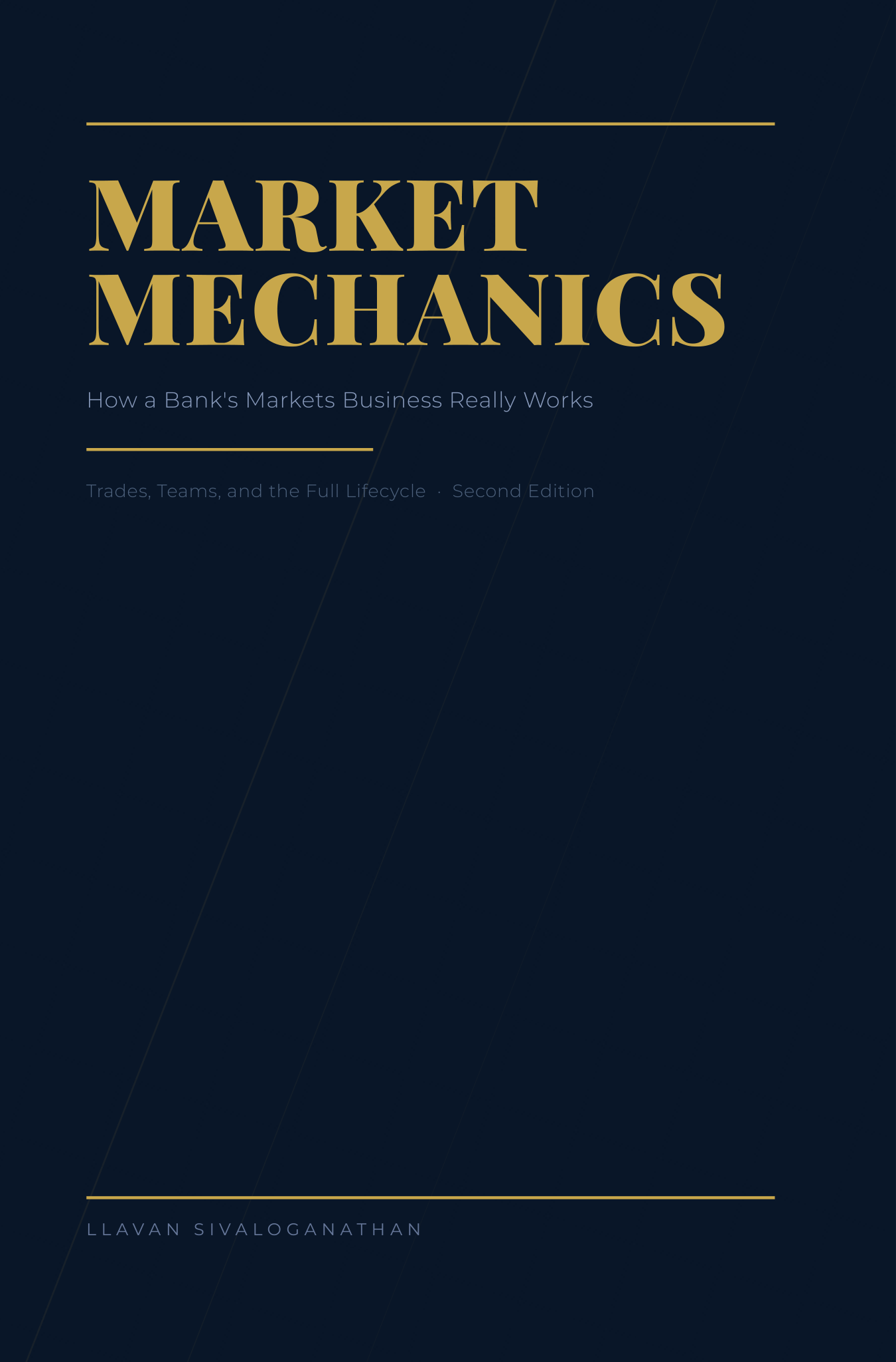
Market Mechanics book cover

Second Edition — Now Available

Market Mechanics

How a Bank's Markets Business Really Works — Trades, Teams, and the Full Lifecycle

Most people in financial services don't understand how the organisation around them actually works. Market Mechanics changes that — tracing every trade from the first client call to the last regulatory report, covering every team, every product, and every stage of the lifecycle.

Written by Llavan Sivaloganathan, Former Director at Citigroup. MBA, London Business School.

23
Diagrams
104
Glossary terms
11
Chapters
11
Appendices
Experience at

What I offer

Services

Senior consulting and interim leadership for financial services organisations navigating Data & AI transformation, regulatory change, and capital markets technology. Director-level accountability and deep domain expertise.

01 GenAI Strategy & Deployment Most GenAI pilots never reach production. I design and deploy GenAI solutions that do — built for the compliance, audit, and regulatory constraints of financial services. From business case and ROI modelling through to working systems with measurable outcomes. Delivered $32m net benefit at Citi through AI-driven data governance and control automation. LLMsRAGAI governance
02 Data Governance & Domain Management Building data frameworks that satisfy regulators, enable AI, and actually get used. Domain ownership models, taxonomies, critical data element standardisation, and automated data quality — designed to withstand ECB, PRA, and OCC scrutiny. Deep expertise in ISO 20022 and BCBS 239. ISO 20022BCBS 239Data quality
03 Regulatory Programme Delivery Complex regulatory commitments delivered on time — every time. Direct engagement with ECB, PRA, OCC, and FRB. Consent order execution, LIBOR to RFR transition, EMIR, Volcker Rule, and Living Will. I translate between regulatory language and business reality at Board and C-suite level. ECB · PRAOCC · FRBEMIR
04 Interim Director & Programme Leadership Senior leadership for high-stakes, high-complexity programmes — budgets to £40m, global teams of 60+, direct C-suite and Board engagement. I step in, take ownership, and deliver. Chaired the Markets & Client Data Council at Citi with EMT and EMT-1 accountability. InterimC-suite£40m budgets
05 Capital Markets Advisory Front-to-back capital markets knowledge — from quantitative analysis through Director level. Rates, FX, Equities, Credit, Structured Products, and Benchmarks. I understand what trading, structuring, quantitative, and operations teams need, and bridge the gap between business and technology. DerivativesBenchmarksFront-to-back

Why me

What sets this apart

Most consultants bring frameworks. I bring experience of doing the work at Director level inside the organisations you are navigating.

$32m
Proven GenAI ROI in production
I have delivered production GenAI inside a regulated Tier-1 institution and tracked the financial impact. I know what works, what does not, and how to get it past legal, compliance, and audit.
Deep
Domain depth, not generalist breadth
Built inside global financial institutions — as a quant, a business analyst, a programme director, and an executive. Capital markets knowledge from the ground up, not from a slide deck.
100%
Flawless regulatory delivery record
Every regulatory commitment I have led has been delivered on time. I know how ECB, PRA, OCC, and FRB think — and I know how to build programmes that satisfy them.

Track record

Delivered outcomes

Measurable impact across Citi, Barclays, Deutsche Bank, Bank of America, and other global financial institutions.

$32m+
Net benefit from production GenAI — data governance automation, control effectiveness, and CDE standardisation at Citi
$800m
Divestment led at Barclays — 20+ workstreams, 9 global regions, 400 people, delivered on time
70%
Reduction in manual data review effort through GenAI automation at Citi
100%
On-time delivery of all regulatory commitments to ECB and PRA — zero missed deadlines
£40m
Maximum programme budget managed — multi-year, multi-geography, with C-suite and Board accountability
60+
Cross-functional global team members led simultaneously across 9 regions on a single programme

Second Edition

Market Mechanics

How a Bank's Markets Business Really Works — the plain-English guide to the trade lifecycle, front/middle/back office, OTC derivatives, clearing, collateral, and EMIR.

Market Mechanics book cover

"The map I wish had existed when I started — covering every trade, every team, and every stage of the lifecycle."

Most people in financial services understand their own piece of the business. Very few understand how the whole system connects. Market Mechanics closes that gap — tracing a trade from first client call to final regulatory report, explaining the role of every team along the way.

Written by Llavan Sivaloganathan, Former Director at Citigroup with over two decades of experience across capital markets at Citi, Barclays, Deutsche Bank, and Bank of America.

The Trade Lifecycle
Execution to Settlement
From the first client call through confirmation, clearing, settlement, and ongoing lifecycle events — every step explained.
The Organisation
Front, Middle & Back Office
What each layer does, how they interact, and where the handoffs — and the breaks — happen.
OTC Derivatives
Products, Clearing & Collateral
Interest rate swaps, credit default swaps, FX options — how they trade, how they clear, and how collateral is managed day to day.
Regulation
EMIR & the Regulatory Framework
What EMIR requires, how it changed the derivatives market, and what it means for operations, compliance, and risk teams every day.
11
Chapters
23
Diagrams
104
Glossary terms
11
Appendices

Who it is for: Students and graduates targeting markets roles · Junior bankers wanting the bigger picture · Professionals in operations, risk, technology, compliance, or legal who work alongside the front office · Anyone preparing for investment banking interviews.

Common questions

About the book

Answers to the questions most people have before reading Market Mechanics.

What is the trade lifecycle in investment banking?
The trade lifecycle covers the full journey of a financial transaction from start to finish. It begins with execution — where a buyer and seller agree the terms of a trade. This is followed by confirmation, where both sides verify that their records of the trade match. The trade then moves to clearing, where a Central Counterparty (CCP) steps between the two sides to manage default risk. Settlement is when the actual exchange of cash or securities occurs. Finally, ongoing lifecycle events — such as coupon payments, rate resets, margin calls, and early terminations — continue for the life of the trade. Market Mechanics traces every one of these stages in plain English, covering who is responsible at each step and what can go wrong.
What is the difference between front office, middle office and back office in a bank?
The front office is where revenue is generated. Trading desks execute transactions and manage market risk. Sales teams win client mandates and maintain relationships. Structurers design bespoke products. This is where P&L is made — and lost. The middle office is the control layer. Product control validates the P&L produced by the front office. Risk management monitors market, credit and operational exposures. Treasury manages the bank's funding and liquidity. The back office — also called operations — is the engine room. It handles trade confirmation, settlement, reconciliation, collateral management, and regulatory reporting (including EMIR). Every trade passes through all three layers. Most problems arise at the handoff points between them. Market Mechanics explains each layer and how they interact.
What is EMIR and what does it mean for banking operations?
EMIR stands for the European Market Infrastructure Regulation. It was introduced after the 2008 financial crisis to reduce systemic risk in derivatives markets. EMIR has three main requirements. The clearing obligation requires that standardised OTC derivatives — such as interest rate swaps and credit default swaps — must be centrally cleared through a CCP rather than settled bilaterally. The reporting obligation requires both counterparties to report all derivative trades to a trade repository, giving regulators full visibility of the market. Risk mitigation techniques apply to non-cleared trades and include timely confirmation, portfolio reconciliation, dispute resolution processes, and daily mark-to-market valuation. EMIR directly affects operations, compliance, legal, and risk teams at every bank operating in Europe. Market Mechanics dedicates a full chapter to EMIR and its practical implications.
How does central clearing work for OTC derivatives?
Central clearing means that instead of two banks facing each other directly in a derivatives trade, a Central Counterparty (CCP) steps between them. The CCP becomes the buyer to every seller and the seller to every buyer — a process called novation. This removes bilateral counterparty credit risk from the system. To protect itself against the risk of a member defaulting, the CCP collects two types of margin. Initial margin is posted upfront and represents a buffer against potential future exposure. Variation margin is exchanged daily based on the mark-to-market movement of the trade — whoever is losing money on a given day pays margin to the other side. Collateral management teams at both banks handle these daily margin flows. Market Mechanics explains clearing, margin, and collateral management in detail, including who does what and how it connects to the front office.
Who is Market Mechanics written for?
Market Mechanics was written for anyone who works in or around a bank's markets business and wants a clearer picture of how it all connects. That includes students and graduates targeting roles in investment banking, capital markets, or financial services who want to understand the business before interviews. It includes junior bankers and analysts who know their own desk but want to understand the broader organisation. It includes professionals in operations, risk, technology, compliance, and legal who work alongside the front office and want to understand what happens before and after a trade reaches them. And it includes anyone preparing for an investment banking interview who wants to demonstrate genuine understanding of how the business works — not just product knowledge.
What OTC derivatives does the book cover?
Market Mechanics covers the key OTC derivative products traded across a bank's markets business, including interest rate swaps, credit default swaps (CDS), FX forwards and options, and equity derivatives. For each product type, the book explains how the instrument works, how it is traded and priced, how it is cleared or settled, what the key risks are, and how operations teams manage the post-trade lifecycle — including confirmation, clearing, collateral, and regulatory reporting under EMIR. The goal is not to make you a derivatives expert, but to give you the mental model you need to understand what your colleagues are doing and why.
Contact

Work with me

Available for senior consulting, interim director, and advisory engagements across Data & AI, regulatory programmes, and capital markets technology for financial services organisations globally. Based in London.

Current availability
Available for new engagements
Open to senior consulting, interim, and advisory roles globally. Short and extended engagements considered.
GenAI strategy Data governance Regulatory programmes Interim director Capital markets

Your details are used only to respond to your enquiry and are never shared with third parties.

Message received.
Thank you for your enquiry. I will be in touch within one business day.